
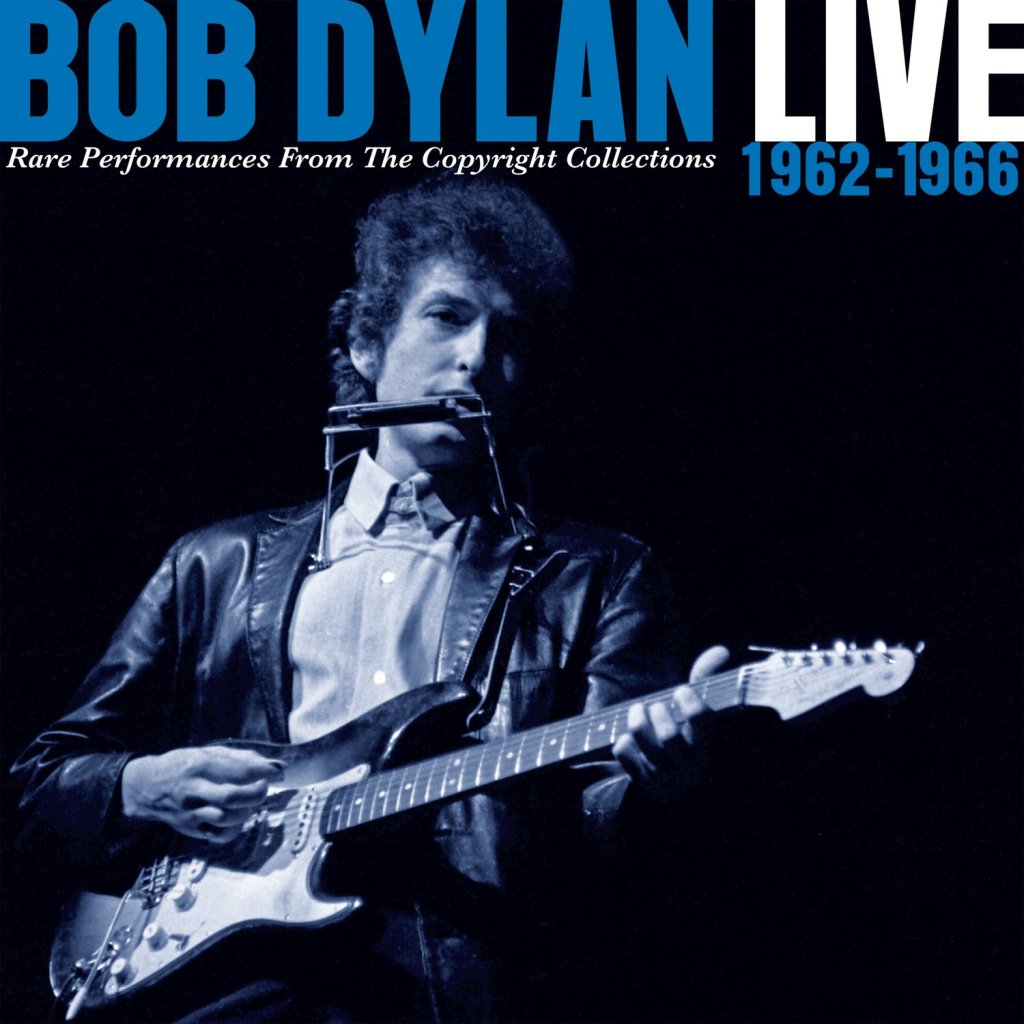
Live 1962-66 – Rare Performances from the Copyright Collections (which I’m calling “Rare Live” from here on) is a valuable by-product of an admin job. Beginning in 2012, each year Sony Music has released a series of multi-disc compilations of Bob Dylan recordings to maintain their European copyright. These 50th anniversary collections are typically extremely limited edition with just 100 copies made available of the first two volumes. Much like some of the more in-depth deluxe Bootleg collections, their existence is a rubber stamp, of interest to only the most dedicated Dylan fans.
Rare Live is a pared-down compilation of 29 live performances from the copyright collection. Originally just for the Japanese market, it inevitably found its way around the world as a more accessible way to hear early live Dylan, especially before the 2025 release of The Bootleg Series Vol. 18: Through the Open Window, a much more comprehensive record of his first performances.
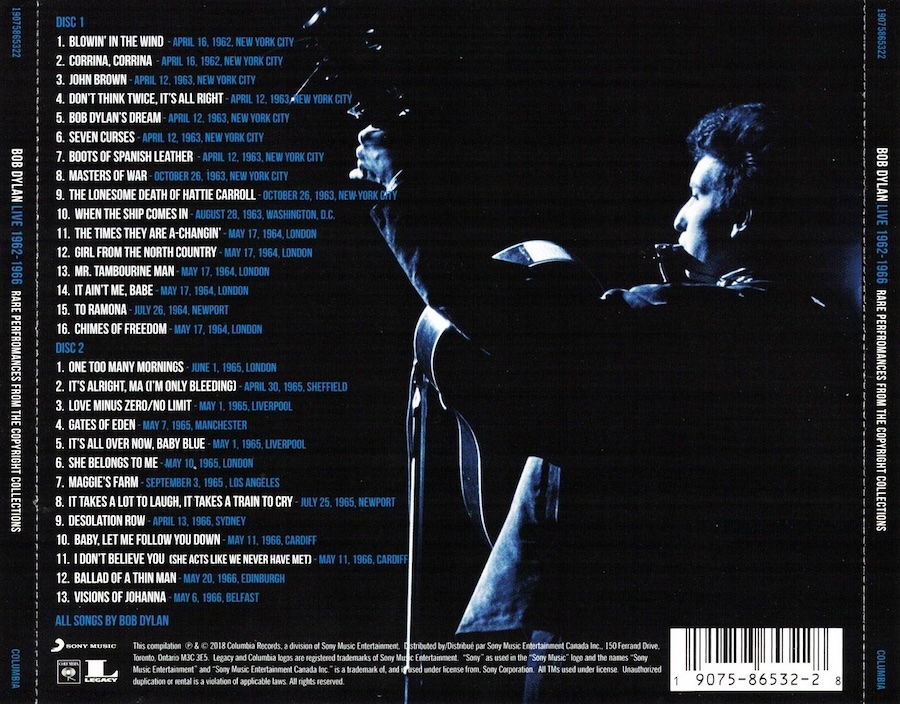
Rare Live opens with history in the making: the first time Bob Dylan performed Blowin’ in the Wind in public. At Gerde’s Folk City on April 16th 1962, he gives his new song a 50-second guitar and harp intro before singing that famous first line. This original Blowin’ in the Wind is slower than the version that will appear on The Freewheelin’ and only has two verses. But it’s remarkable that we can hear this initial incarnation – a seminal moment in the life of Bob Dylan and the wider world.
Earlier in this Gerde’s set, he played another Freewheelin’ song, Corrina, Corrina. The album version is one of the few early Dylan recordings that features a backing band (though they’re hardly The Hawks), so it’s nice to hear Dylan’s solo take here. He begins Corrina, Corrina with an offhand comment that makes the Gerde’s crowd laugh – a nice reminder of how genial and fun he was in those early live shows. His guitar playing and vocals are excellent, while there are some surprising lyrical switches.
When Dylan sings “I got a devil on my trail and a hellhound by my side”, it’s like an extreme twist on the familiar, sweeter album version. This line also re-emphasizes his song’s debt to Robert Johnson, especially his song Stones in my Passway from which Dylan lifts the “bird that whistles” line and its repeated “I got a…and a…” format. I recently revisited the full five-song Gerdes set – now available on Bootleg Vol. 18 – as a thread on X, which you can find here:
One of the early peaks of Dylan live recordings happened at New York’s Town Hall a year later. Rare Live has a clear and confident Town Hall take on John Brown, the anti-war song he had previously played at The Gaslight Café. This is the last time he will perform the song until Jerry Garcia persuaded him to revisit it during his 1987 tour with The Grateful Dead. John Brown will also be a surprise inclusion in Dylan’s mid-90s MTV Unplugged show.
Dylan draws out the melancholy of Don’t Think Twice, It’s All Right at the April 1963 Town Hall show, while playing with the vocal melody. However, he then forgets his tweaked phrasing in one of the later verses before overcompensating for his error in a ragged final stanza. Don’t Think Twice had been part of Dylan’s repertoire since the previous year, but Bob Dylan’s Dream is a new song for the Town Hall crowd, unless they caught its debut at Gerdes two months earlier. This good performance is only slightly marred by some ringing feedback from his vocal mic.
Bob Dylan’s Dream was one of 10 Town Hall songs to be included on Bootleg Vol. 18, but I’d still love an official release of the full concert. That would include a couple of set highlights, which feature on Rare Live, such as the debut of Boots of Spanish Leather. After a lovely, picked guitar introduction, Dylan weaves the story’s wondrous spell through a soft, sorrowful performance. Another gem is his pulsing, poised rendition of Seven Curses, which had only previously been officially available as a a studio outtake on the first volumes of The Bootleg Series and the demo for Witmark.
Dylan played Seven Curses six months later at his triumphant Carnegie Hall headline show in October 1963. By this point, we’ve reached firm protest-era Dylan and he delivers Masters of War at the legendary New York venue with a low-broiling fury, while a new high-string strum adds melodic menace to the music. There’s more excellent guitar playing on a passionate first-time performance of The Lonesome Death of Hattie Carroll. Dylan introduces short flourishes after some of the choruses, expanding the musicality of a song that is typically more about the words. While Rare Live only gives us two songs from this important show, you can now hear the entire performance on Bootleg Vol. 18.
Rare Live provides another moment of history with a song from Dylan’s appearance at The March on Washington in August 1963. The scratchy, resonant recording from that famous day opens with a man saying: “I can tell from your applause he needs no further introduction…Mr. Bob Dylan.” Dylan plays When the Ship Comes In with vigor and is complemented by Joan Baez’s at-first hesitant but later resolute backing vocals. It’s an appropriately compelling and triumphant opening to such a significant set.

Dylan will go on to play Only a Pawn in their Game to the masses gathered in Washington, which proved a touch more contentious – as I explored in my revisit to The Times They Are a-Changin’. The title track of that album provided the regular opener to his live performances during this period, as we hear on Rare Live from London’s Royal Festival Hall in May 1964. Dylan had questioned the validity of his protest anthem after the assassination of JFK in November of the previous year. While his Festival Hall lyrical tweak of “The cross is bending / the curse it is cast” doesn’t seem fully thought through, it feels like he was trying to incorporate some sense of doubt to The Times They Are a-Changin’s strident certainty.
In 1964, the singer was looking to expand his horizons beyond topical songs and Rare Live is also interested in the other side of Bob Dylan. We get a fine Royal Festival Hall version of Girl From the North Country and debuts of a few significant songs. Many live performances of It Ain’t Me Babe from around this time see Dylan accompanied by Joan Baez, so it’s nice to hear his solo take. It’s sadder and more wistful than the firm version that closes his Another Side record and avoids the playfulness that comes when Baez is involved.
The Royal Festival Hall show hosted the first outing for Mr. Tambourine Man. While this live take is slower than the studio version we’ll eventually hear on Bringing It All Back Home, this Dylan masterpiece is largely in place by April 1964. Dylan had written Mr. Tambourine Man on a trip across the US earlier that year and the Festival Hall audience witnessed the debut of another song written on the road. The extraordinary Chimes of Freedom will undergo some lyrical reshaping but this measured performance is superior to the shoutier take he’ll unleash at The Newport Festival of Folk later that summer.
Rare Live provides one moment from Bob Dylan’s triumphant appearance at Newport ’64: a somewhat forced performance of To Ramona with a mercifully toned-down harmonica than the shrill version he’ll play at The Philharmonic in October. The collection returns to the UK for performances from the 1965 tour that was captured in DA Pennebakker’s documentary Dont Look Back. Dylan plays One Too Many Mornings at BBC Studios with even more mournfulness than the album take, plus a new emphasis on “behind” that foreshadows the following year’s raucous electric version.
US Presidents standing naked gets a big laugh from Dylan’s Sheffield audience, without breaking the spell of a mesmerizing performance of It’s Alright Ma (I’m Only Bleeding). This April 1965 show happened just a month after Bringing It All Back Home was released, but Dylan’s delivery is already markedly different. His voice is more open and inviting, as opposed to the album’s tone of stern admonishment. He understands that the crowd already agrees with him so he can cut the hectoring without letting anyone off the hook for their complicity in capitalism’s long and crooked chargesheet.
Though he later claimed to have been bored of his acoustic framework during this tour, Dylan often sounds in great form. He is calm and confident on Love Minus Zero/No Limits in Liverpool, which starts with a long harmonica intro that I would have loved more of at the end. If this near-perfect performance has a flaw, it’s that it’s over too quickly. At the same show in Liverpool, Dylan gets a lot of bass out of his acoustic guitar on It’s All Over Now, Baby Blue. Though nothing beats the haughty, disdainful version he plays to Donovan in a room at the Savoy Hotel that Pennebaker recorded and included in his film for brutal posterity.
Dylan remains un-heckled at Manchester’s Free Trade Hall during a loose and lithe version of Gates of Eden. While his phrasing is more precise than usual, the song lacks a strict rhythm. He speeds up and slows down at will, drifting into empty spaces as if to emphasise the dreamy nature of the lyrics. The Royal Albert Hall is also a welcoming venue in 1965. Dylan’s wonderful performance of She Belongs to Me is a jaunty contrast to the hushed, breathy take he’ll deliver throughout the controversial 1966 tour. This section of Rare Live is the magnificent calm before the storm.
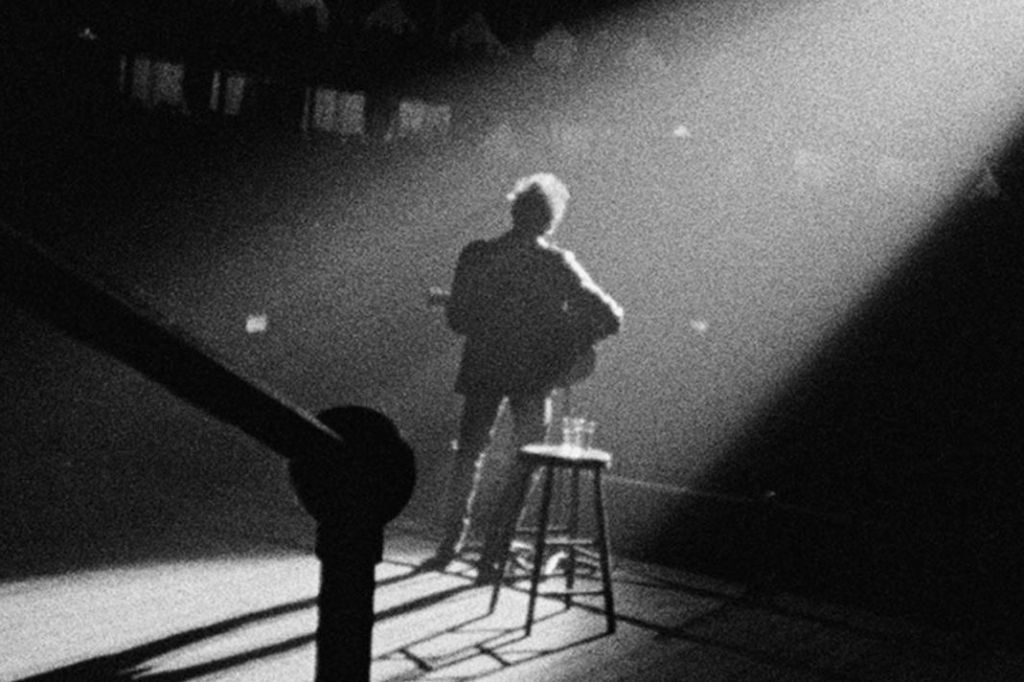
In July 1965, Bob Dylan announced his new electric side with a shocking plugged-in version of Maggie’s Farm at the Newport Festival of Folk. On Rare Live we hear that Dylan and his band have toned it down two months later. The Maggie’s Farm they play at LA’s Hollywood Bowl in September 1965 is less aggressive and kinda funky, especially that slappin’ Al Kooper organ.
Rare Live revisits that infamous 1965 Newport appearance with It Takes a Lot to Laugh, It Takes a Train to Cry. It’s a song that went through many evolutions before its final Highway 61 Revisited album version. At Newport, the song adapts to the band especially Mike Bloomfield’s explosive guitar work. It was the conclusion of a controversially short set and at the end we hear Dylan order his band off, saying “Let’s go man, that’s all.”
Next comes an epic tempo change in the form of a lovely solo acoustic version of Desolation Row, as performed for TCN-9 TV in Sydney in April 1966. I love that Dylan decided to take over a full ten minutes of airtime, but it passes so fast as he envelopes the listener in that masterfully-drawn cruel and unusual world.
Then we hit the UK for the infamous electric tour that I covered extensively in my revisit to Bootleg Vol. 4. On Rare Live, we get two songs from Cardiff’s Capitol Theatre, where a rowdy Baby Let Me Follow You Down is greeted with applause by Dylan’s Welsh fans. I Don’t Believe You gets the iconic “it used to go like that, now it goes like this” introduction. At Cardiff, it sounds more like the joke he probably initially intended it to be than the challenge it became later. I really like the extra-sinister version of Ballad of a Thin Man from Edinburgh’s ABC Theatre. Though as with the Free Trade Hall version, there’s a lot of distortion on Dylan’s vocals.
The obvious place to end Rare Live would be with Like a Rolling Stone. The original Japanese version of the compilation does this with that Judas-fuelled version from Manchester. But the US/European Rare Live omits the song entirely, instead concluding with a solo Visions of Johanna from Belfast’s ABC Theatre. I’m always happy to listen to any performance of this masterpiece, even if my favorite live take remains the one I first heard on Biograph, from the penultimate date of the tour at Royal Albert Hall.
Like most of the 1966 section of Rare Live, these are performances many Dylan fans will have heard a version of before, while Bootleg Vol. 18 offers a more extensive exploration of his earliest live shows. But overall the collection is a delightful summary of Dylan’s early years and his development of a live performer. With historic debuts, unique takes and exceptional versions of great songs, it’s of interest to aficionados while also being a great best-of record. Rare Live – available on some popular streaming platforms – is a fine starting point for anyone looking to get an overview of early live Bob.
What did you think of Rare Live? Let me know in the Comments below. If you’re enjoying this revisits, you can support my work by buying me a coffee here.


 Home
Home 
Leave a comment