
Five people take the unlit stage at Brighton Centre and begin to play their instruments. When the lights go up, if you squint hard enough you can spot Bob Dylan in amongst them: seated with his back to the audience, playing a guitar we can’t quite see.
If you hadn’t caught a recent Dylan live show before, you might have been waiting for a moment when the spotlit headline act strides from stage right to roars of excitement. But this is not a typical rock concert with greetings and gratitude – or even the slightest acknowledgement that thousands of people have taken the time and paid of lot of money to be there.
I recently watched an interview with British folk singer Martin Carthy, who, when discussing Dylan’s many unexpected musical shifts, noted that he never goes to where the audience is. Dylan always makes people come to him. That is almost exactly how a contemporary Bob Dylan show plays out.
He sits behind a piano covered with deliberately-placed objects of obscurement, in a dim, unchanging glow that defies all standard notions of stagecraft like movement, dynamism and spotlights (the two large unused ones placed on either side of the stage seems to be Bob’s little joke). In Brighton, he even eschews the occasional moments that I’ve seen previously, where he stands by his piano, awkward hand-on-hip, to absorb some end-of-song applause.
Bob not’s coming to you, but gradually I found myself completely captivated by him. It didn’t start out that way. The opening instrumental introduction sees the band lock into a tight, rocking groove that reminds me of Thunder on the Mountain, the opening song on his exceptional 2006 album, Modern Times. But when Dylan removes his guitar and faces the microphone to sing, I’m soon concerned that this great group was going to be let down by its frontman.
When recording his first album way back in 1962, Dylan’s producer John Hammond complained that the singer kept wandering away from the microphone. 60 years later, he remains frustratingly inconsistent about ensuring his voice is completely captured and amplified. I feel like I missed all the first lines of the show’s inaugural song so it took a while before I realised that it was I’ll Be Your Baby Tonight. Despite the very satisfying accompaniment, Dylan’s half-assed approach to his vocals was concerning.
Happily, my worries were dissipated by the next song. This began with another lengthy instrumental jam but Bob Britt’s beautiful guitar licks (it may also have been Dylan but it was often hard to tell exactly what he was playing cos of the whole turning his back thing) soon coalesced into the hook of It Ain’t Me Babe. When Dylan returned to the microphone, it was like a different singer. He was suddenly committed, his phrasing dramatic and he delivered the song’s big moments with grace and power.
As ever with these Rough and Rowdy Ways shows, things start to really click when Dylan plays the songs from his most recent album. First, we get a shimmering, spirited I Contain Multitudes followed by the bawdy stomp of False Prophet. It’s always a delightful reminder of just how good these songs are and their match for his current voice makes them the best songs to hear Dylan play live now. Later, as he crows his way through an enthralling Cross the Rubicon, I’m not sure how a seated octogenarian is managing to emit so much damn swagger.
That these are Rough and Rowdy Ways centred shows isn’t to everyone’s taste. A few people I spoke with afterwards wanted to hear more from the early Dylan back catalogue with one older fan even content with the new arrangements of those 60s classics like It Ain’t Me Babe and a fascinating interpretation of It’s All Over Now, Baby Blue, which possibly gets the biggest reception of the evening.
One of my highlights of the evening is a pulsating Desolation Row. Though Jim Keltner is no longer on sticks, the band’s latest drummer Anton Fig has retained a version of the palpitating snares that propel Dylan’s great epic through its latest glorious live incarnation. The song also featured the first instance of Dylan’s harmonica playing, which got the crowd very excited. My only complaint is that we are only treated to about half of the song’s original verses – I would have loved this rendition to keep going for another five minutes.
Another peak was the early triptych of avant-garde-tinged performances that began with the charming instrumental recreation of the 50s novelty song Istanbul (Not Constantinople), with a touch of Putting on the Ritz. Then Dylan starts singing When I Paint My Masterpiece and it’s hard to believe that this seemingly timeless pairing of music and words didn’t exist until a few years ago. The exotic tune is matched by the striking images of Rome, Brussels, lions and those newspaper men eating candy that Dylan delivers with a beautifully judged extravagance.
He follows it with the endlessly mysterious Black Rider – my favourite song from the 2024 Royal Albert Hall show I saw and still worth the price of admission, especially with the echoing effects after each delivery of the title line. Then comes a pared-back and deliciously weird My Own Version of You, which Fig embellishes with instinctive and whimsical crashes and rattles on a diverse range of percussion instruments.
After this comes To Be Alone With You, acting as a mild palette cleanser but also a sign that things may flag during the second half of the show. While I love Key West as the drifting conclusion to Rough and Rowdy Ways, my attention waned during this rendition (maybe I was still thinking about the brilliant Desolation Row that preceded it).
Watching the River Flow was easily the weakest moment of the set and I don’t get why Dylan remains so enthralled with this song. That half of this current live set’s non-Rough and Rowdy Ways songs are from his post-motorcycle crash decade of drift is something that someone with more smarts than me should investigate in depth (I nominate Laura Tenschert).
Most of the remaining Rough and Rowdy Ways material doesn’t escape the second-half slump. I didn’t love the staccato delivery of I’ve Made Up My Mind to Give Myself To You, which sapped a lot of the sweetness from one of Dylan’s purest love songs. While Mother of Muses was as gorgeous as ever, the usually reliable Goodbye Jimmy Reed seemed to lack some of the rough and rowdiness that normally brings the show towards its climax.
The conclusion of this familiar setlist remains Every Grain of Sand and it is pure poetry, both in the words and the heartbreaking harmonica interludes. And then, Bob finally rises from his station and looks out into the darkness with the barest of admissions that there was a whole bunch of people out there hanging on his every word.
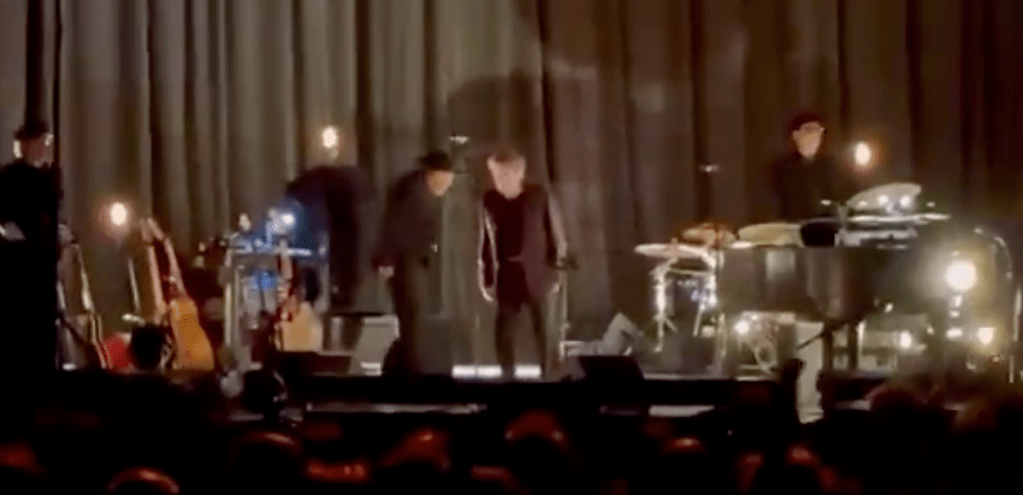
Though perhaps not everyone. If the restlessness of the Brighton Centre audience is anything to go by, a lot of people weren’t so captivated by Dylan that they could remain in their seats for the show’s duration. The wide-open spaces of this conference centre proved too irresistible for many and the flow of traffic to the toilets, bars and maybe the exits was unrelenting all evening.
Obviously, this is a lot more noticeable and intrusive at an all-seater show and gig goers are not usually known for staying in one place. But you wouldn’t expect that level of audience activity at a play or classical concert. It’d be nice if a performer like Dylan could be afforded the same level of respect.
But hey, we all had different reasons to be there. Many present at Brighton Centre went to see Bob Dylan the legend, the singer of powerful protest songs, the sneering rock star of Like a Rolling Stone. If they’ve recently witnessed legacy acts like The Rolling Stones or Bruce Springsteen, they might also expect a reasonable facsimile of the glory days from Dylan. Like the nice man next to me who rated the show as “ok”, they’d wouldn’t have anticipated that half the set would be songs newer than anything in, say, One Direction’s back catalogue.
Yet, we’re all drawn by the same power that has been compelling people to seek out Dylan since he first turned up in Greenwich Village. No matter that they knew he wasn’t going to give them what they wanted. From the folk purists who turned up to boo his electric shows in the mid-60s, to those assuming they’d see a greatest hits act from an aging rock star instead of a mature artist continuing to pursue his own interests and ambitions.
At Brighton Centre, as at countless venues across the US, Europe and beyond, the Rough and Rowdy Ways tour remain divisive. But if you are willing to accept that this is not a concert that conforms to tradition, if you can meet an artist where they stand, you will be rewarded.
This is Bob Dylan. You come to him.

 Home
Home 
Leave a comment