
Just one month after unleashing his rock monster Highway 61 Revisited on the world, Bob Dylan released an absolute belter of a single called Positively 4th Street.
This song wasn’t on Dylan’s latest album, which modern record company executives with marketing budgets in mind must think is an insane thing to do. But back in the 1960s, it was more common. For example, She Loves You didn’t appear on a Beatles album in the UK.
Dylan was in the middle of a run of three classic albums that would have a major impact on folk music, rock’n’roll and the vinyl format. Yet he’s still able to land a knockout one-off like Positively 4th Street.
Dylan fans have long speculated about the subject of Positively 4th Street’s flurry of lyrical jabs. Candidates include detractors from the 4th Street-centered Greenwich Village folk scene like Izzy Young, Phil Ochs and Irwin Silber, or ex-lover Edie Sedgwick.
For me, that’s not what’s most interesting about the song. This is Highway 61 Dylan, an album whose lyrics generally defy straightforward analysis. Yet, Positively 4th Street is extraordinarily blunt in its intention and interpretation.

Positively 4th Street was recorded on the first day of the Highway 61 Revisited album sessions with Bob Johnston having replaced Tom Wilson at the mixing desk The new producer asked what the song was called and Dylan replied “Black Dally Rue”. There’s no reference to that working title or the final one in the song’s lyrics, just like on the album tracks It Takes a Lot to Laugh, It Takes a Train to Cry and Just Like Tom Thumb’s Blues. And all three of these songs forgo a chorus or refrain.
Al Kooper is back, having insinuated himself into Dylan’s backing band on the Like a Rolling Stone session. He’s once again throwing musical punches with those haymaking organ riffs, which coupled with the pugnacious lyrical attack on an unnamed person, makes Positively 4th Street a sequel of sorts to Dylan’s hit singer.
But whereas Like a Rolling Stone, with its Siamese cats and mystery tramps, has striking images and poetic flourishes, 4th Street is a straight up passage of putdowns. It’s a throwback to the directness of protest Dylan, but this time it’s about injustices committed against himself.
While the lines burn, the delivery doesn’t. Like a Rolling Stone has snarl, Positively 4th Street is more dismissive. Dylan doesn’t “come out once and scream it”, instead he rolls off curt ripostes that cut more with the coldness of his tongue.
Let’s just list some:
- “You’ve got a lot of nerve to say you are my friend.”
- “You just want to be on the side that’s winning.”
- “You have no faith to lose and you know it.”
It all culminates in an entire verse that builds up to a pricelessly cynical rewrite of that upbeat aphorism about walking a mile in someone else’s shoes:
“Yes, I wish that for just one time, you could walk inside my shoes. You’d know what a drag it is to see you.”
The lesson is: never cross Dylan. He can be a real dick and it works for him. Positively 4th Street was a top 10 hit in the US and UK. When Joni Mitchell heard it, she was inspired, realizing that “you can write about anything in songs”.
Popular music wasn’t about dissing people. But once again, Dylan got right up in the face of convention, questioned its integrity then left it alone, all flush-faced and humiliated. And he’s certainly not finished rubbing people up the wrong way.
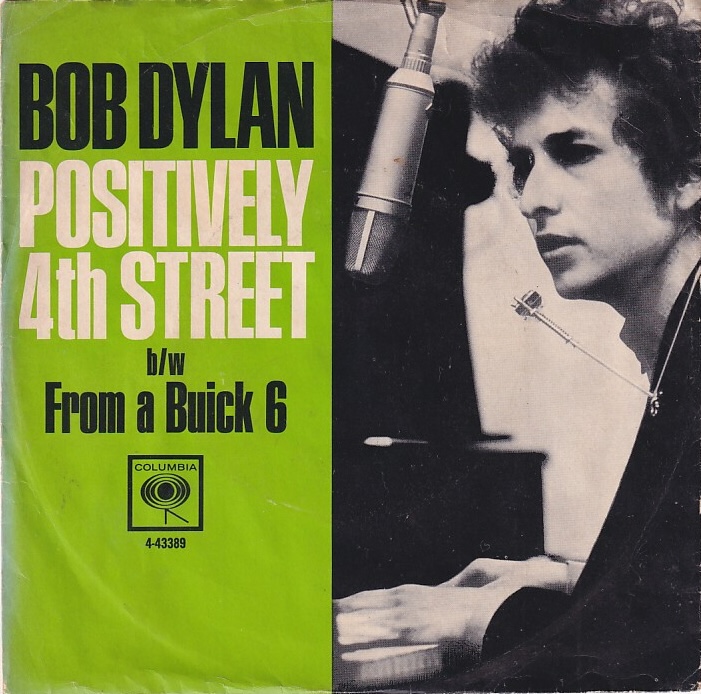
What do you think of Positively 4th Street? Have you ever used one of its insults in real life? Let me know in the Comments.


 Home
Home 
Leave a comment